Language:



Selecting a catalyst for ozone off‑gas abatement in wastewater treatment plants hinges on fully recognizing the harsh service conditions—high humidity (relative humidity often >95%), hydrogen sulfide (H₂S at 5‑50 ppm, sometimes exceeding 100 ppm), and ammonia (NH₃ at 5‑30 ppm). Under these aggressive conditions, off‑the‑shelf catalysts not specifically designed for this environment can experience service life shortened to merely 20‑30% of that in normal industrial exhaust streams. Catalytic decomposition is significantly superior to activated carbon adsorption and thermal decomposition in terms of safety, energy consumption, and engineering practicality. Moisture resistance, resistance to combined sulfur/ammonia poisoning, conversion efficiency matched with space velocity, mechanical strength and service life, and safety/total lifecycle cost are the five core dimensions for selecting ozone destruction catalysts in wastewater treatment plant off‑gas systems. This article systematically examines the catalyst‑based technical pathway for ozone abatement in municipal and industrial wastewater treatment, covering off‑gas sources and characteristics, hazard analysis, technology comparison, catalytic principles, failure mechanisms, selection criteria, engineering implementation, and field case studies.
Ozone‑based advanced oxidation is widely used in the advanced treatment stage of wastewater treatment plants, primarily for decolorization, disinfection, and degradation of recalcitrant COD. During this process, ozone dosage typically ranges from several milligrams to tens of milligrams per liter of water, but only a portion is consumed in oxidation reactions; the remainder is discharged as residual ozone in the off‑gas. Typical off‑gas ozone volume fractions range from 0.5% to 3%.
The compositions of off‑gas from different process units vary, yet share common characteristics. Off‑gas from equalization tanks and anaerobic tanks contains H₂S at 5‑50 ppm, and in some high‑strength cases can exceed 100 ppm; NH₃ concentrations are generally 5‑30 ppm. Off‑gas from aeration basins has lower H₂S (typically <5 ppm) but carries substantial droplets and bioaerosols. Off‑gas temperatures generally range from 15‑35°C, with relative humidity (RH) of 95‑100%—even after cooling and condensation in pipelines, the RH often remains above 80% upon entry to the treatment unit.
Compared with flue gas or chemical plant exhaust, wastewater treatment off‑gas exhibits three critical differences: (1) reduced sulfur (H₂S) and NH₃ coexist at relatively high concentrations with similar orders of magnitude; (2) moisture content is extremely high, with virtually no dry period; and (3) sub‑micron bioaerosol concentrations reach 10³‑10⁵ particles/cm³ and are sticky. These characteristics dictate that the failure mode is not simple sulfur poisoning alone, but rather a synergistic attack from moisture, ammonium sulfate/sulfite salts, and particulate fouling.
Ozone is a powerful oxidizer, and excessive off‑gas emissions pose multiple risks.
Health risks: Ozone directly irritates the conjunctiva and the entire respiratory tract. According to China’s Occupational Exposure Limits for Hazardous Agents in the Workplace – Part 1: Chemical Hazardous Agents (GBZ 2.1‑2019), the maximum allowable concentration (MAC) of ozone in workplace air is 0.3 mg/m³. In areas near ozone contact tanks and ozone destructors, without effective control, ozone levels can far exceed this limit.
Equipment corrosion: Ozone accelerates corrosion of metal piping, valves, fan blades, and other equipment, shortening service life and increasing maintenance costs. Off‑gas from ozone contact tanks is often laden with moisture, and the condensate that forms in pipelines can be acidic, further aggravating corrosion.
Environmental compliance: Under the Ambient Air Quality Standard (GB3095‑2012), ozone is a routine monitoring indicator. Direct emission of untreated ozone off‑gas contributes to ground‑level ozone pollution and exposes operators to increasingly stringent environmental enforcement.
Currently, three main technical approaches are used for treating ozone‑containing off‑gas.
| Method | Principle | Advantages | Disadvantages |
|---|---|---|---|
| Activated Carbon Adsorption | Physical adsorption | Immediate initial effect, simple equipment | Efficiency drops sharply at high humidity, saturates quickly, risk of spontaneous combustion |
| Thermal Decomposition | Heating to 300‑400°C | Thorough decomposition | Extremely energy‑intensive, complex equipment, high operating cost |
| Catalytic Decomposition | Ambient‑temperature catalysis | Very low energy use, no secondary pollution, suitable for continuous operation | Requires proper selection to cope with high‑humidity and sulfur‑containing conditions |
Catalytic decomposition has become the most mainstream route for ozone off‑gas abatement in wastewater treatment plants.
Ozone (O₃) is a high‑energy molecule with three oxygen atoms; it slowly decomposes to oxygen at room temperature, but the natural rate is far too slow to meet industrial abatement time scales. The catalyst provides a lower‑activation‑energy pathway.
The overall catalytic reaction is: 2O₃ → 3O₂. As the ozone‑laden off‑gas passes through the catalyst bed, ozone molecules first adsorb onto active sites on the catalyst surface. The catalyst, typically composed of transition metal oxides such as manganese dioxide and copper oxide, donates electrons to the ozone molecule, weakening the O‑O bond and ultimately converting it to oxygen. Ozone decomposition is exothermic (ΔH = ‑142 kJ/mol); at elevated ozone concentrations, the bed temperature rise can reach 10‑30°C.
High‑performance ozone decomposition catalysts generally employ a manganese‑copper mixed oxide system, formed into a stable composite oxide structure through co‑precipitation and high‑temperature calcination. The catalyst contains numerous micropores and high specific surface area, effectively adsorbing ozone and facilitating the decomposition. The entire process proceeds rapidly at off‑gas temperatures of 30‑60°C, requiring no additional heating energy.
The off‑gas environment in wastewater treatment plants poses unique challenges to catalysts. Understanding these three failure mechanisms is essential for scientific selection.
Water molecules compete directly with ozone for active sites. Test data show that at an ozone inlet concentration of 50 ppm, space velocity 10,000 h⁻¹, and 25°C, increasing RH from <5% to 90% causes initial conversion to drop from 99.2% to 84.6%. After 200 hours of continuous operation, the conversion at 90% RH further decreases to 68.2%, accompanied by a 41% loss in specific surface area. High humidity not only causes reversible competitive adsorption but also leads to irreversible hydrothermal aging—crystallite growth of active components. In saturated off‑gas, a continuous water film forms on the catalyst surface, so ozone must first dissolve in the film before diffusing to active sites; mass‑transfer resistance increases by an order of magnitude.
This is the most distinguishing feature of wastewater treatment off‑gas compared to other industrial scenarios. The coexistence of H₂S and NH₃ produces a strong synergistic effect. Parallel accelerated aging tests (RH=85%, 25°C, 50 ppm ozone) show that after 300 hours of operation, the conversion with 20 ppm H₂S alone is 52.7%; with 20 ppm NH₃ alone, 81.6%; but with both present, the conversion is only 26.8%—far faster than simple addition. The mechanism: H₂S is oxidized to SO₂/SO₃ on the catalyst surface, which then reacts with NH₃ to form ammonium sulfate or ammonium sulfite. These salts are solid at room temperature and rapidly deposit on the surface and within pores, reducing specific surface area from 156 m²/g to 68 m²/g and pore volume by over 60%. This salt deposition does not rely on consumption of active components and proceeds much faster than sulfur poisoning alone.
Bioaerosols in the off‑gas have particle sizes mainly in the range of 0.1‑10 µm, with 0.3‑1 µm particles most prone to deposition in micropores; oil mist originates from volatilized lubricating oil from blowers. These materials neither react nor decompose, but form sticky coatings on the catalyst surface. Field data show that with only primary filtration upstream, after six months of operation, the conversion at the inlet section of the catalyst bed is only 38% of fresh material, while the outlet section still retains 82%.
Based on the above characteristics and failure mechanisms, the following five core dimensions should be prioritized when selecting ozone destruction catalysts for wastewater treatment off‑gas.
Off‑gas humidity in wastewater treatment is often near saturation. For conventional catalysts, measurable decay in decomposition efficiency begins when RH exceeds 60%. Preference should be given to catalytic systems that have undergone hydrophobic modification or rare‑earth doping to ensure stable operation at 90% RH. Mn‑Ce mixed oxides or Mn‑Ce‑Sn ternary systems are preferred directions—cerium and tin serve as sulfur‑resistant promoters that effectively slow sulfation rates (comparative tests show that Mn‑Ce catalysts maintain 68% conversion after 500 hours at 20 ppm H₂S and 80% RH, versus only 41% for Mn‑alone catalysts).
Sulfur‑ and ammonia‑containing off‑gas requires poison‑resistant formulations. The poisoning efficiency of sulfides scales exponentially with concentration: increasing H₂S from 1 ppm to 10 ppm reduces catalyst half‑life from 800 hours to 120 hours. Selection should emphasize stability data of the catalyst in mixed H₂S/NH₃ atmospheres.
High‑efficiency catalysts should achieve initial conversion >99% at space velocities of 5,000‑10,000 h⁻¹, with inlet ozone concentrations of 1%‑3%, ensuring outlet concentration below the 0.1 ppm safety limit. For high‑flow applications, catalysts capable of higher space velocities (≥15,000 h⁻¹) are preferred to reduce equipment size and fan energy consumption. Space velocity is the core design parameter—too low leads to oversized equipment and higher capital cost; too high results in insufficient residence time and reduced conversion.
Catalysts in the bed must withstand long‑term gas flow and vibration. Insufficient mechanical strength leads to particle breakage and pulverization, causing increased pressure drop and higher fan load. The normal service life should typically be 3‑5 years.
Quality catalysts contain no activated carbon or combustible components, eliminating the risk of heat accumulation and combustion due to exothermic ozone oxidation. Selection should not focus solely on unit price; instead, total lifecycle cost should be evaluated—including catalyst cost, replacement labor, production losses, and compliance expenses. A lower‑priced catalyst with shorter life and frequent replacement often results in higher annualized cost.
The following aspects are critical for field implementation of catalysts in wastewater treatment plants.
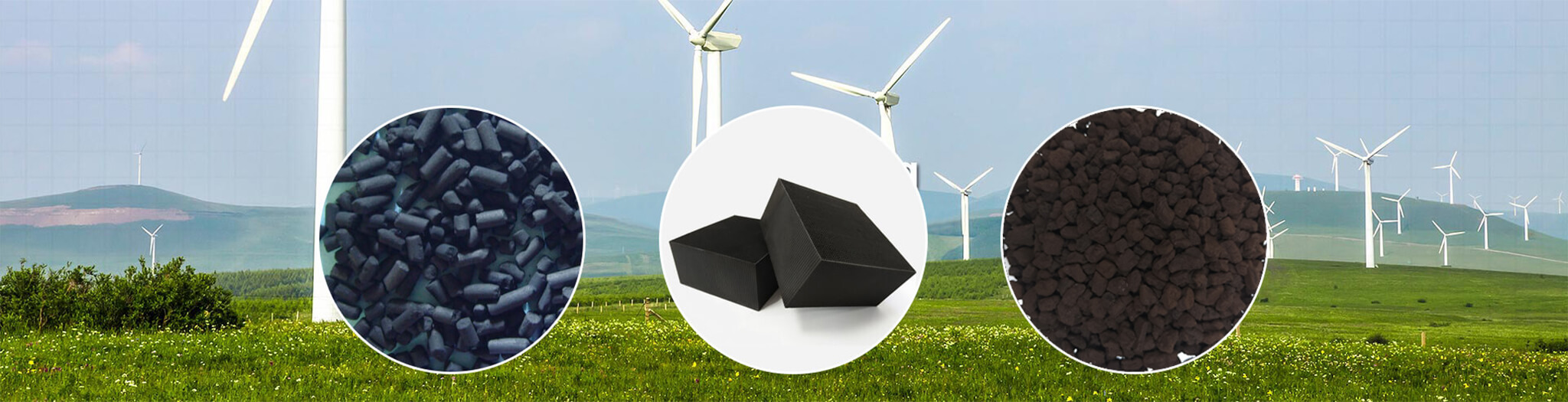
Catalysts can be manufactured as cylindrical pellets, granules, or irregular particles in various sizes, and can be customized as needed. The final form should be determined based on off‑gas flow rate, dust loading, and installation space.
The catalyst is loaded into an ozone destructor (reactor vessel), through which the ozone‑laden off‑gas is driven by a fan. Ozone is decomposed to oxygen at ambient temperature as it passes through the catalyst bed. Key design considerations include uniform flow distribution and sufficient contact time.
Given the high‑humidity nature of wastewater off‑gas, gas‑liquid separation or mist elimination devices should be installed upstream of the catalyst bed. For dust‑laden off‑gas, efficient filtration should be provided to remove aerosols and oil mist. Where sulfide levels are high, additional pretreatment (e.g., activated carbon guard beds) is recommended.
A regular inspection schedule should be established to monitor ozone concentrations before and after the catalyst bed, as well as bed pressure drop. When efficiency falls below a set threshold, regeneration options can be evaluated—heating to 120‑150°C with purging for 2‑4 hours, or operating at reduced humidity (<30%) for 12 hours, can restore over 90% of the original activity.
The following case data are derived from actual industrial applications to provide reference for technical evaluation.
An industrial park wastewater treatment plant used ozone for advanced treatment of industrial wastewater, generating substantial ozone off‑gas that could not meet emission standards. The plant installed 500 kg of ozone decomposition catalyst loaded into four ozone destructor units. Operating at ambient temperature, the catalyst effectively decomposed residual ozone off‑gas, achieving compliant emissions.
A wastewater treatment unit carried out systematic optimization of its ozone off‑gas treatment system, covering process flow, catalyst type, and destructor design. Post‑retrofit operational data showed that the optimized catalytic decomposition process offered high automation, high ozone decomposition efficiency, and stable outlet ozone concentrations meeting the requirements of the Ambient Air Quality Standard (GB3095‑2012).
Selecting catalysts for ozone off‑gas abatement in wastewater treatment plants hinges on fully recognizing the unique challenges of high humidity, sulfur, and ammonia coexisting in the off‑gas. Under these conditions, catalysts face three simultaneous failure mechanisms—moisture competition, ammonium salt deposition from combined sulfur/ammonia poisoning, and physical plugging by aerosols. Without specific design for this environment, catalyst service life can be drastically shortened.
Moisture resistance, resistance to combined sulfur/ammonia poisoning, conversion efficiency matched with space velocity, mechanical strength and service life, and safety/total lifecycle cost are the five core dimensions for selection. A rational selection path is: define process parameters → balance space velocity and efficiency → prioritize moisture‑ and poison‑resistant formulations → evaluate total lifecycle cost → finalize the technical solution.
Catalytic decomposition, with its technical maturity and economic viability, offers a quantifiable and replicable engineering pathway for ozone off‑gas abatement in wastewater treatment plants. Proper catalyst selection and system design—including upstream dehumidification, poison‑resistant formulation choice, and routine monitoring—are the fundamental guarantees for long‑term, stable compliance.
Contact: Candyly
Phone: 18142685208
Tel: 0731-84115166
Email: minstrong@minstrongchina.com
Add: E2 Building, Kinglory Science And Technology Industrial Park, Wangcheng Area, Changsha, Hunan, China.