Language:



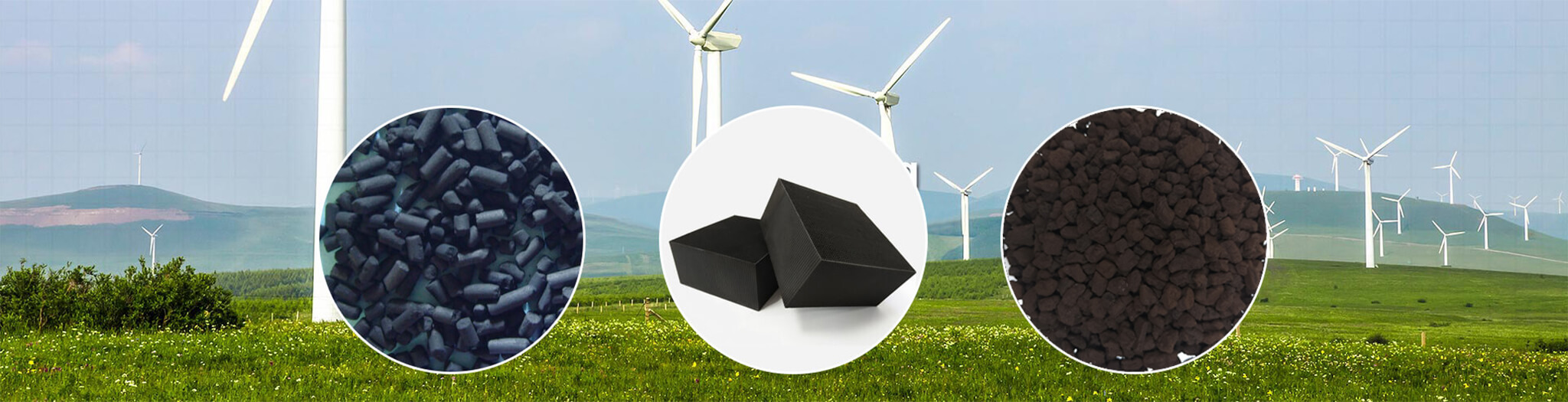
Hopcalite is a non-precious metal composite oxide catalyst primarily composed of activated manganese dioxide (MnO₂) and copper oxide (CuO). It was jointly developed in 1919 by Johns Hopkins University and the University of California, and its name is derived from a combination of the two institutions' names.The MnO₂:CuO mass ratio in the classic binary formulation is approximately 3:2 to 2:3. In industry, quaternary formulations with added cobalt oxide or trace silver are also used to improve moisture resistance or thermal stability.
The catalytic activity of Hopcalite originates from continuous electron transfer between copper and manganese ions via lattice oxygen.The reversible redox cycle between Cu²⁺/Cu⁺ and Mn⁴⁺/Mn³⁺ forms a dynamic oxygen reservoir: MnO₂ readily releases surface lattice oxygen to participate in oxidation reactions and is partially reduced itself, while CuO efficiently dissociates and adsorbs oxygen from the gas phase, fills oxygen vacancies, and restores catalyst activity.CO catalytic oxidation follows the Mars-van Krevelen mechanism: CO reacts with surface lattice oxygen to form CO₂ and leaves an oxygen vacancy, which is then replenished by gas-phase O₂ to complete the cycle.This mechanism enables Hopcalite to rapidly convert CO to CO₂ within a temperature range of -20°C to 50°C, far below the 200°C or higher reaction temperature required without a catalyst.
Typical performance indicators for high-quality Hopcalite catalysts include: specific surface area of 180–240 m²/g, active component content ≥80% (granular), average crushing strength >45 N/cm, bulk density of approximately 0.7 g/mL, operating temperature range of -20°C to 50°C (short-term up to 150°C), and single-pass CO conversion of >99% under dry, clean conditions.
Catalytic oxidation of CO is the most mature application of Hopcalite.Under ambient temperature (0–40°C) and pressure, the catalyst efficiently converts highly toxic CO into harmless CO₂ according to the reaction: 2CO + O₂ → 2CO₂.The catalytic process is highly selective, reacting only with CO without affecting oxygen or nitrogen in the air, enabling precise purification.
The copper-to-manganese molar ratio is a key parameter determining low-temperature activity.When the Cu:Mn molar ratio is between 1:1 and 1:2, the space velocity required to achieve over 90% CO conversion at 25°C can reach up to 30,000 h⁻¹.Deviation from this range significantly reduces activity: excess copper (molar ratio >1:1) causes a copper-rich surface phase to cover manganese active sites, reducing conversion to below 70%; excess manganese (molar ratio <1:2) decreases activity by approximately 30% due to intensified lattice distortion.Measured data show that at 25°C, 40% relative humidity, and 20,000 h⁻¹ space velocity, a sample with Cu:Mn = 1:1.5 achieves an initial CO conversion of 98.2%, while a sample with Cu:Mn = 1:3 reaches only 72.5%.
Crystal phase structure significantly affects activity.Low-crystallinity samples obtained by calcination at 280–350°C (crystallinity <15%) exhibit a specific activity at 25°C approximately 2.3 times that of highly crystalline samples (calcined at 500°C, crystallinity >50%), because the low-crystalline state contains abundant oxygen vacancies and unsaturated coordination sites.
After a mine fire or gas explosion, CO concentrations can briefly exceed 5000 ppm, far above the 24 ppm safety threshold.In a coal mine refuge chamber test, when external CO intrusion raised the internal concentration to 500 ppm, a purification device loaded with Hopcalite catalyst reduced the CO concentration to below 20 ppm within 15 minutes, and it remained stable within the safe range for 8 hours of continuous operation.In a 2023 coal mine fire accident in Shanxi, 32 miners relied on a CO purification system for 12 continuous hours inside a refuge chamber, maintaining CO concentration at 18 ppm, and all miners were eventually rescued safely.
A multi-scale heat and mass transfer optimization study for CO removal in refuge chambers, targeting the requirement to reduce CO from 400 ppm to 24 ppm within 20 minutes, determined an optimal parameter combination of 3 mm catalyst particles, space velocity of 6327 h⁻¹, and air changes of 9.7 h⁻¹.The study also identified 33°C as the energy efficiency threshold for CO removal with Hopcalite; beyond this temperature, energy costs increase disproportionately.
Hopcalite is a core material for CO purification in gas mask canisters, mining self-rescuers, and fire escape hoods.In fixed purification systems, the catalyst in mine refuge chambers is typically replaced every 15–30 days; under high humidity or high dust concentration conditions, this should be shortened to 7–14 days.In industrial air separation purification systems under clean, dry conditions, high-quality catalysts can last 12–18 months.
Hopcalite exhibits excellent ozone decomposition capability, rapidly decomposing ozone into oxygen at ambient temperature (2O₃ → 3O₂) without heating or UV assistance, producing no secondary pollutants.Its decomposition mechanism is similar to CO oxidation: ozone molecules adsorb onto surface oxygen vacancies and rapidly dissociate through electron transfer.
The key difference from physical adsorbents such as activated carbon is that Hopcalite's ozone decomposition is a chemical catalytic process with no adsorption saturation issue, resulting in a longer service life.Activated carbon relies on pore structure for physical adsorption of ozone, with limited adsorption capacity and requiring replacement or regeneration upon saturation; Hopcalite continuously converts ozone to oxygen through catalytic reaction, and the catalyst itself is not consumed in the theoretical cycle.
Application scenarios include: tail gas destruction units for ozone contact tanks in water treatment plants and wastewater treatment plants; downstream purification of UV disinfection equipment to decompose escaped ozone tail gas; and museums, libraries, and other places requiring removal of trace ozone to protect artifacts.High-quality Hopcalite catalysts contain no combustible or volatile components and pose no combustion risk when treating high-concentration ozone.
Hopcalite exhibits catalytic oxidation activity toward certain volatile organic compounds, capable of treating formaldehyde (HCHO), ethylene oxide (C₂H₄O), toluene (C₇H₈), and other gases, oxidizing them to CO₂ and H₂O.The reaction pathway involves adsorption of VOC molecules on the copper-manganese oxide surface, cleavage of C-H or C-O bonds, and deep oxidation of intermediates.
Under microwave-assisted conditions, the catalytic oxidation of benzene by Hopcalite is significantly enhanced.At a microwave power of 70 W, initial benzene concentration of 1,917 mg/m³, gas flow rate of 1.0 L/min, and catalyst bed height of 3.86 cm, benzene conversion reaches 99.2%, with higher energy utilization than conventional heating.
The catalytic behavior of chlorinated volatile organic compounds differs.Studies show that the conversion of chloroform, trichloroethylene, and dichlorodifluoromethane decreases as concentration increases.
Hopcalite's catalytic efficiency for VOCs is generally lower than for CO, and the reactivity of different VOCs varies considerably.In practical applications, Hopcalite is more suitable for treating industrial tail gases coexisting with CO (such as coking and petrochemical industry exhaust) to achieve synergistic multi-pollutant control, rather than as a dedicated VOC catalyst.
In dry gas streams (0–60°C), Hopcalite can remove hydrogen through chemisorption.The copper-to-manganese molar ratio is a key control parameter: Hopcalite with a Cu/Mn molar ratio greater than 0.55 has higher hydrogen capacity and lower sensitivity to CO₂.As the Cu/Mn molar ratio increases from about 0.5, hydrogen capacity increases accordingly, peaking at a Cu/Mn ratio of about 3; however, when the Cu/Mn ratio exceeds about 7, hydrogen capacity becomes lower than that of standard Hopcalite catalysts.
This capability is applied in hydrogen stream purification for fuel cell systems, pre-purification in air separation systems, and other scenarios.Compared with precious metal catalysts such as palladium and platinum, Hopcalite is less sensitive to trace air impurities such as water, CO₂, NOₓ, and SOₓ, and its cost is far lower than that of precious metal catalysts.
In underground mine blasting fume purification, Hopcalite possesses simultaneous catalytic conversion capability for CO and NO₂.Laboratory simulated device tests show that heating can effectively solve the water poisoning problem of Hopcalite catalysts, and there is a clear quantitative relationship between preheating temperature, stabilization time, space velocity, and CO/NO₂ conversion.In practical engineering, Hopcalite is typically used in conjunction with pretreatment devices for synergistic NOₓ and CO purification in tunnel ventilation systems, underground engineering working faces, and similar scenarios.
Humidity is the primary limiting factor for Hopcalite performance.When ambient relative humidity exceeds 45%, water molecules compete with CO for catalyst surface active sites, causing a sharp decline in catalytic efficiency.The effects of moisture manifest at three levels: water molecules occupy active sites and reduce CO adsorption capacity; moisture interferes with the redox cycle and electron transfer of metal oxides; and water entering catalyst pores increases gas diffusion resistance.
The cumulative effect of long-term exposure is also significant.When a conventional product is placed in a 50% humidity environment for 1 year, the specific surface area decreases from 200 m²/g to 120 m²/g, and catalytic efficiency drops from 95% to 70%.When relative humidity exceeds 60%, conversion can decrease by more than 50% within a few hours.
The core engineering principle is "dry first, then catalyze".Install a high-efficiency drying unit at the catalyst inlet to reduce the air dew point to below -40°C, ensuring that the gas entering the catalyst bed is sufficiently dry.At the same time, adopt an intermittent operation mode: when CO concentration drops to a safe threshold, remove the catalyst bed from the gas flow path to avoid cumulative poisoning caused by continuous penetration of moisture-containing gas.
Hopcalite is extremely sensitive to sulfides.Sulfides such as H₂S and SO₂ react with copper-manganese oxides to form stable sulfates, altering the catalyst surface chemistry.Trace amounts (ppm level) of sulfides can cause permanent poisoning.In cases of mild sulfur poisoning, partial regeneration can be achieved by inert gas thermal purging (150–300°C) to remove some physically adsorbed H₂S or sulfite species; however, when poison concentration exceeds 100 ppm or continuous exposure exceeds 100 hours, active sites suffer permanent damage.
Engineering countermeasures include installing an activated carbon or desulfurization adsorbent layer before the catalyst layer to delay the time for poisons to reach the catalyst surface.In sulfur-containing scenarios such as industrial flue gas, upstream desulfurization is a necessary step to ensure Hopcalite service life.
For activity decline caused by water vapor poisoning (reversible deactivation), thermal regeneration is the most cost-effective repair method.Conventional regeneration parameters are heating at 150–200°C; for water poisoning scenarios, preheating at 80–150°C with stabilization for 2–20 minutes can be used, with optimal parameters being heating at 100–130°C for 4–10 minutes.These regeneration conditions can typically restore catalytic efficiency to over 90% of the initial level.
A mine application case illustrates the practical effect of regeneration: a mine used Hopcalite to purify blasting fumes underground, and high humidity caused rapid catalyst poisoning and a significant drop in purification rate.Using on-site thermal regeneration technology, the deactivated catalyst was heated at 120°C for 8 minutes, and the catalytic efficiency after regeneration recovered to 92% of the initial level, replacing the traditional local ventilation method and reducing maintenance costs.
After regeneration, activity testing is required to ensure CO catalytic efficiency reaches 85% or above.The moisture and sulfur resistance of regenerated catalyst slightly declines, and the operating environment humidity should be controlled below 60%.If catalytic efficiency remains below 85% and shows no significant recovery after thermal regeneration, the catalyst should be replaced.
| Gas Type | Chemical Formula | Reaction Products | Typical Conversion/Performance | Applicable Conditions | Maturity |
|---|---|---|---|---|---|
| Carbon monoxide | CO | CO₂ | >99% (dry conditions) | Ambient temperature, dry and clean | Most mature |
| Ozone | O₃ | O₂ | Near complete decomposition | Ambient temperature, no saturation issue | Mature |
| Formaldehyde | HCHO | CO₂ + H₂O | Catalytically active | Ambient temperature, humidity control required | Extended |
| Benzene | C₆H₆ | CO₂ + H₂O | 99.2% under microwave assistance | Microwave-assisted conditions | Extended |
| Chloroform/Trichloroethylene | CHCl₃/C₂HCl₃ | CO₂ + H₂O + HCl | Conversion decreases with increasing concentration | Process optimization required | Laboratory stage |
| Hydrogen | H₂ | Chemisorption removal | Depends on Cu/Mn ratio (optimal >0.55) | Dry gas stream, 0–60°C | Specific scenarios |
| Nitrogen oxides | NO₂ | Synergistic conditions required | Synergistic purification with CO | Blasting fume purification, etc. | Specific scenarios |
The core treatment target of Hopcalite is carbon monoxide, which is its most mature application with the most comprehensive data.Ozone decomposition is the second mature application, featuring ambient-temperature chemical catalysis, no adsorption saturation issue, and high engineering reliability.VOC treatment is an extended capability suitable for synergistic treatment of industrial tail gases coexisting with CO; under microwave-assisted conditions, high conversion can be achieved for specific VOCs such as benzene.In addition, Hopcalite can remove hydrogen through chemisorption and synergistically treat nitrogen oxides under specific conditions.
Engineering application effectiveness highly depends on systematic control of humidity, sulfides, and operating conditions.The core contradiction lies in the tension between the catalyst's sensitivity to water vapor and the high-humidity characteristics of actual working conditions.Drying layer design and regeneration strategies are key means to mitigate this contradiction.Future improvement directions focus on moisture-resistant modification (reducing water molecule adsorption affinity through surface hydrophobization or rare earth doping) and intelligent operation management (dynamically controlling catalyst working status based on real-time CO and humidity monitoring).
Contact: Candyly
Phone: 18142685208
Tel: 0731-84115166
Email: minstrong@minstrongchina.com
Add: E2 Building, Kinglory Science And Technology Industrial Park, Wangcheng Area, Changsha, Hunan, China.