Can VOCs and Ozone in Industrial Exhaust Be Removed by One Catalyst?
In industrial waste gas, VOCs (volatile organic compounds) and ozone often coexist. Ozone may originate from secondary pollutants generated by photochemical reactions or from residues not fully consumed in pretreatment units such as low-temperature plasma. Traditionally, these two types of pollutants are treated separately: ozone is first decomposed by heating or catalysis, followed by VOCs treatment using adsorption or combustion technologies. This approach involves large equipment, high energy consumption, and complex processes. A natural question arises: can both types of pollutants be treated simultaneously using a single catalyst in a single reactor? The answer is yes. Through a rationally designed bifunctional catalyst, the active oxygen species generated from ozone decomposition can act as oxidants for the deep oxidation of VOCs, achieving synergistic removal of "two birds with one stone." Under optimized process conditions, VOCs mineralization can reach over 90%, and ozone simultaneous decomposition rate exceeds 98%, without the need for additional oxidants.
I. Synergistic Catalysis: How to Achieve "Two Birds with One Stone"
The core of synergistic catalysis lies in utilizing ozone molecules as a "carrier" for active oxygen. On the surface of the bifunctional catalyst, ozone molecules are first adsorbed onto active sites (such as oxygen vacancies or Lewis acid sites of transition metal ions). Through electron transfer, ozone decomposes into an oxygen molecule and a highly reactive atomic oxygen (O·), or further reacts with water molecules in the environment to generate hydroxyl radicals (·OH). These reactive oxygen species have oxidation potentials as high as 2.42 V and 2.80 V, respectively, far exceeding those of ordinary oxygen, and can attack carbon-carbon and carbon-hydrogen bonds in VOCs molecules under ambient or even low-temperature conditions, gradually oxidizing them to CO₂ and H₂O.
During the reaction, the lattice oxygen on the catalyst surface participates in the oxidation process, leaving oxygen vacancies that become active centers for the next ozone molecule decomposition, forming a closed loop of "ozone decomposition → generation of reactive oxygen → oxidation of VOCs → regeneration of oxygen vacancies". Kinetic studies show that on the Mn-Co composite oxide catalyst, the apparent activation energy for ozone decomposition is approximately 35–50 kJ/mol, while the rate-limiting energy barrier for VOCs oxidation can be reduced by more than 20% due to the participation of reactive oxygen species. This coupling mechanism enables thermocatalytic oxidation, which originally required temperatures above 250℃, to operate efficiently in the mid-to-low temperature range of 50-100℃.
II. What materials can meet the dual-function requirement? The key to achieving "killing two birds with one stone" lies in the catalytic material possessing both high ozone decomposition activity and excellent VOCs oxidation capacity. Relatively mature material systems in engineering practice include the following:
Manganese-based oxides: MnO₂, Mn₂O₃, and mullite-type oxides (such as SmMn₂O₅) exhibit outstanding performance due to the multiple valence states of manganese (+2, +3, +4) and abundant oxygen vacancies. Under standard test conditions (40% humidity, space velocity 10,000 h⁻¹), α-MnO₂ achieves an initial ozone decomposition efficiency of up to 99% and an oxidation efficiency of approximately 85% for toluene. The advantages of manganese-based materials are low cost and high activity; the disadvantage is relatively weak resistance to high humidity.
Cobalt-based and cobalt-manganese composite oxides: Co₃O₄ exhibits superior activity compared to manganese at low temperatures, but its resistance to moisture is worse. Combining cobalt and manganese to form a Mn-Co-O solid solution can combine the advantages of both. Data shows that after 300 hours of continuous operation, the ozone decomposition efficiency of a catalyst with a Mn/Co molar ratio of 1:1 decreases by less than 5%. In the composite system, cobalt provides high oxidation activity, while manganese enhances structural stability, resulting in a synergistic effect.
Transition metal multi-component composite systems: Binary or ternary combinations such as iron-manganese, cerium-manganese, and copper-manganese further expand the performance boundaries. Among them, Ce-Mn-O has attracted much attention due to cerium's oxygen storage capacity (Ce⁴⁺/Ce³⁺ cycle). Experiments show that the catalyst with Ce/Mn=0.2 only extends the ozone half-life by 15% at 80% relative humidity, far lower than the 60% extension rate of the pure manganese catalyst. The addition of cerium significantly improves moisture resistance.
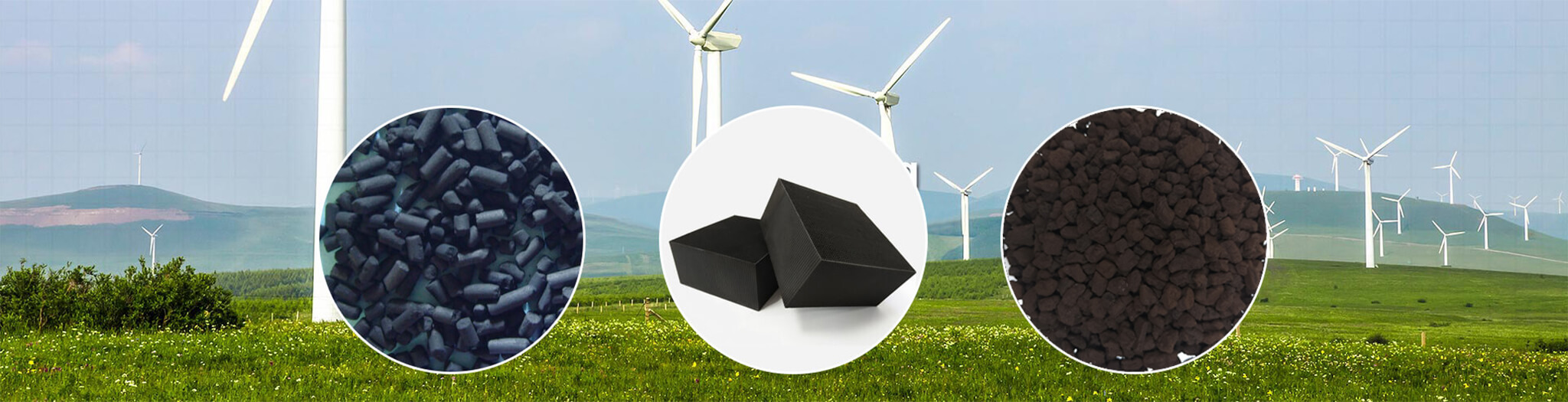
Supported catalysts: Coating the above-mentioned active components onto honeycomb ceramic, metal foam, or molecular sieve supports can reduce gas flow pressure drop and improve mechanical strength. Example products, such as the "Minstrom" series of manganese-based honeycomb catalysts, have been validated in engineering for their ability to simultaneously decompose ozone and benzene oxides within the 50–120°C range. While precious metals (Pt, Pd) offer higher activity, their high cost limits their use, limiting their selection to cleanrooms with extremely high purification requirements or specialized processes.
III. Key Engineering Parameters Affecting Synergistic Effects
Even with excellent catalyst performance, improper control of process parameters can significantly reduce synergistic effects. The following three parameters are most critical:
Humidity: Water molecules compete with ozone for adsorption active sites and may generate stable hydroxyl species on the catalyst surface, covering the active centers. When relative humidity exceeds 60%, the ozone decomposition efficiency of most manganese-based catalysts decreases by 10–30%. Countermeasures include: hydrophobic modification of the catalyst (e.g., silane surface treatment), selection of Ce-Mn composite systems, or installation of condensation and dehumidification devices at the reactor front end. Experiments show that the hydrophobically modified sample retains 85% of its initial activity at 80% RH.
Temperature: Co-catalysis can operate over a wide temperature range of 0–150 °C, but trade-offs exist between different temperature ranges. At low temperatures (<20 °C), water molecules may condense on the catalyst surface, exacerbating deactivation; at high temperatures (>200 °C), the ozone thermal decomposition rate accelerates, competing with intrinsic catalytic decomposition, and the catalyst crystal phase may change (e.g., MnO₂ transforms into Mn₂O₃). Considering both efficiency and energy consumption, the optimal economical temperature range is 40–90 °C. Within this range, manganese-based catalysts exhibit high ozone decomposition rates and VOCs oxidation activity.
Space velocity: Space velocity (the volume of gas processed per unit volume of catalyst per unit time) determines the contact time between the gas and the catalyst. For monolithic honeycomb catalysts, the commonly used space velocity range is 5,000–20,000 h⁻¹. Too low a space velocity will result in excessively large equipment size and increased investment; too high a space velocity will lead to incomplete reaction and excessive outlet concentration. The recommended initial space velocity for this project is 10,000 h⁻¹, which can be adjusted upwards or downwards based on actual outlet measurement data. Experience shows that when the space velocity increases from 8,000 h⁻¹ to 15,000 h⁻¹, the VOCs removal rate typically decreases by 5-10 percentage points. To maintain the removal rate, the catalyst loading must be increased or the airflow distribution optimized.
IV. Precautions during project implementation
Exhaust gas pretreatment: Before entering the catalyst bed, the exhaust gas must undergo sufficient pretreatment. The particulate matter concentration should be below 5 mg/m³, otherwise it will physically clog the micropores and channels of the catalyst. Oil mist, siloxanes, and sulfides (H₂S, SO₂) are major enemies of the catalyst: siloxanes decompose on the catalyst surface to generate silica, permanently covering the active sites; sulfides react with transition metals to form metal sulfates, leading to irreversible deactivation. The standard pretreatment process includes: baghouse dust collection, oil removal filters, and a dedicated adsorption protective bed for siloxanes. Engineering statistics show that proper pretreatment can extend catalyst lifespan by 3-5 times.
Deactivation Mechanisms and Regeneration Strategies
Catalyst deactivation is classified into reversible and irreversible deactivation. Reversible deactivation is mainly caused by water molecules, carbonates, or adsorbed organic matter covering active sites and can be recovered through regeneration. On-site regeneration typically involves purging with hot air at 200-300°C for 1-2 hours, achieving a recovery rate of 80-95%. For severe carbon buildup, hot air containing trace amounts of ozone can be introduced to accelerate the oxidation of carbonaceous species. Irreversible deactivation is caused by chemical poisoning from sulfur, phosphorus, or silicon, or high-temperature sintering (>400°C), in which case catalyst replacement is necessary. In a well-pretreated system, the typical replacement cycle for manganese-based catalysts is 8,000-12,000 hours. Regular regeneration not only restores activity but also extends overall lifespan by 30%-50%.
System Integration Key Points
Sampling ports should be installed before and after the catalyst bed for online monitoring of ozone and VOCs concentrations. Installing a differential pressure sensor can determine blockage; when the pressure drop exceeds 50% of the initial value, backflushing or inspection of the pretreatment process is required. For intermittent production conditions (such as spray painting lines and printing presses), a bypass system is recommended to prevent low-temperature, high-humidity exhaust gas from directly contacting the catalyst during shutdown, which could lead to condensation and deactivation.
Returning to the initial question: Can the same catalyst effectively remove both VOCs and ozone present in industrial waste gas? Practice has shown that by selecting manganese-based or cobalt-manganese composite bifunctional catalysts and rationally controlling engineering parameters such as humidity, temperature, and space velocity, coupled with a comprehensive pretreatment and periodic regeneration system, simultaneous and efficient removal of both pollutants is entirely possible. Compared to separate treatment processes, the synergistic catalysis route can reduce equipment investment by approximately 25%–35%, reduce operating energy consumption by approximately 40%, and simplify the operation process. For industrial scenarios facing the coexistence of ozone byproducts and VOCs, this technical solution provides a practical, cost-effective, and efficient option.
author:Gloria
date:2026-05-08